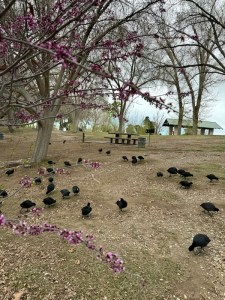
I’m reveling in the last of our cooler days, because come summer, instead of enjoying the sounds of birds while out on a hiking trail or at a park, I’ll likely be listening to the incessant ‘tweets’ of espresso machines and the roar of frothers emanating from behind a coffee counter.
That’s because the time of year is approaching when the Mojave Desert asserts itself in a way that can’t be ignored: — namely, by blasting Southern Nevadans with blazing temps.
Last summer certainly was a scorcher. We shattered records by hitting 120F, exceeding by 3 degrees the previous hottest day of 117F. We also had 112 days of 100F-plus temperatures, topping the record of 100 days during summer 2023. And experts are anticipating more of the same this year.
Cafes are a good place to take haven, with their frigid micro-climates. They pump up the AC enough to seemingly simulate being on a peak in the Spring Mountains, where it’s typically about 10-20 degrees cooler.
Down in the valley, many people seem quasi-conscious as they go about shopping and other errands during summer months. Pigeons take cover beneath parked cars — not much of a respite, but at least they’re shielded from the blistering sun.
Creosote bush, meanwhile, copes quite deftly, after its nearly 12,000-year presence in our arid hometown. While younger bushes are more vulnerable to severe lack of water, older ones establish root systems highly adept at water absorption, creating “dead zones” around them and hence fending off competitors. And the waxy coating on their leaves helps them retain water — a feature of many other desert plants and trees.
Me? I sit slurping iced coffee at my local cafe.
Speaking of water, our drought continues, with areas in Southern Nevada ranging from the Exceptional Drought category (in the Lake Meade area) to the status of Extreme Drought (in most of Clark County and in the Spring Mountains), according to the National Weather Service.
Which is a bummer, because here in Southern Nevada, in case you weren’t aware, we love to rush to the closest window and watch the miracle of wetness on the rare days that it rains.
But precipitation was below normal in March, despite several inches of snow having fallen over the southern Great Basin along with 1 to 2 feet over the Sierra and Spring Mountains, according to a statement on the agency’s website.

And as you can see above in the photo, things are looking pretty dire at Hoover Dam, which feeds Lake Mead, and it’s not looking any better at Lake Powell (< this video takes you on a quick tour). The Colorado River provides water for both lakes.
Our scant precipitation has resulted in sparse vegetation and lack of water for bighorn sheep in Valley of Fire State Park, disruption to migration patterns of deer and elk in Spring Valley State Park, as well as an increase in invasive plant species in Cathedral Gorge State Park, the National Weather Service statement says. It states that through at least June, there is a 33 percent to 60 percent chance of 1) above-normal temperatures and 2) below normal precipitation.

 the prickly pressed
Leave a comment