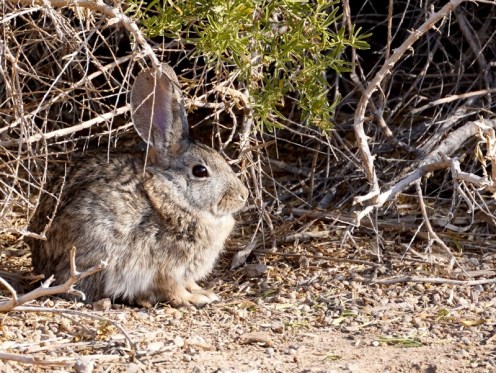
Spotted a desert cottontail recently trying to make itself invisible at the Clark County Wetlands Park. Not difficult for it to do, as this creature’s fur matches the landscape perfectly. But its onyx eyes were the giveaway — shiny and expectant.
This was typical behavior, considering my presence. “Sometimes they will freeze when danger lurks and scrunch down to blend into their surroundings,” states the Nevada Department of Wildlife website, “or they slowly try to sneak away to safety.” Which is exactly what this cottontail did: it took off into the brush after less than a minute. I know when I’m not wanted!
Camouflage is one of the cottontail’s main self-defense tactics. After all, they’re slow runners: their speeds reach up to only 15 mph, according to the National Audubon Society’s Field Guide to Mammals: North America. “Rabbits, less proficient runners, often elude enemies by hiding in dense cover,” the guide states. Whereas the black-tailed jackrabbit, also found in Southern Nevada, can reach speeds of 30-35 mph, according to the field guide. The hare’s white-tailed counterpart, found only in Northern Nevada, can run up to 45 mph, the field guide says.
As for the black-tailed hare, I happened to spot one a few days ago from a distance as it dashed across the landscape at Floyd Lamb Park at Tule Springs. No wonder multiple birds of prey were hovering overhead in this scrubland section.
 the prickly pressed
Leave a comment