
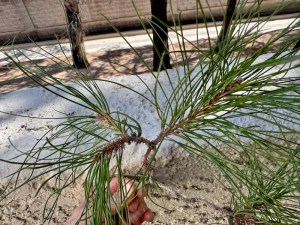
Despite what’s stated on Google Maps and local street signage, the trees encircling my apartment complex are not what I thought they were.
Living at this complex for some years now – a stone’s throw from Torrey Pines Drive – I naively surmised I was in the presence of torrey pine trees.
I was smitten by the local connection!
But that was far from the case. In fact, the closest torrey pine tree is about 327 miles away from me – namely, at the Torrey Pines State Natural Reserve in San Diego, Calif. Torrey pines also are considered critically endangered (a more severe status than endangered) by the National Audubon Society, due to a dwindling population.
Fact-finding mission
Pines can be a pain to distinguish. They all look so similar, so you need to do your homework. So I wandered into my leasing office to inquire (probably a lazy thing to do). I learned only that my complex was built in 1989.

OK, that was a start. I then did some more research. I checked several field guides from my reference library, did some searches online and checked the reference section at my local library. I discovered that the closet fit was the afghan pine, which was commonly used during the population boom of the ’80s and ’90s in Southern Nevada to provide shade and privacy at residential and commercial sites, as well as parks.
Getting into the weeds on pines
I read up on the size of the pine needles and the cones, as well as other physical characteristics. I found out, for instance, that torrey pine needles grow to 8-12 inches in clusters of five (for any tree nerds out there), and the cones are about 4-6 inches long. Meanwhile, afghan pine needles grow to 4-6 inches in clusters of two or three, and the cones are about 2-3 inches.
I delved into the details of other types of pine trees, as well, and the upshot was that the pine trees near my house were native to Afghanistan, Pakistan and parts of the Middle East, not the desert Southwest. What a bummer.
One of the issues with this is that afghan pine trees live only 50-60 years in urban settings. They also are an unwise choice when it comes to water use and overall adaptability. On the flip side, trees native to the Southwest, such as mesquite, desert willow, Palo Verde and acacia, also can provide shade and privacy and require notably less water.
Since 2000, there’s apparently been a trend in landscaping to replace pines with more desert-adapted trees, such as the ones mentioned above. And newer complexes are more apt to use native trees, as well.
 the prickly pressed