
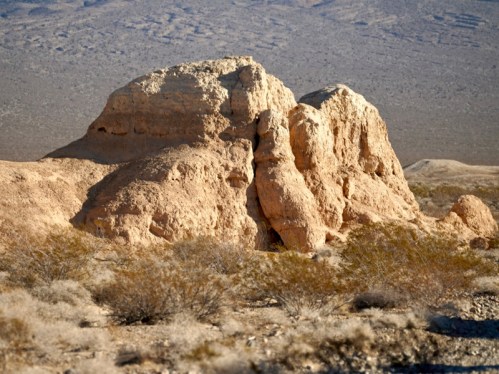
A small group of horned larks took me by surprise today at the Tule Springs Fossil Beds National Monument. They fluttered so suddenly near a small creosote bush and chirped in chorus before dispersing just as quickly and flying away from the park.
I had just finished photographing some sandstone outcroppings and was on my way back to my car. I managed to get only one shot of one of the birds, and it was a lousy one at that, because my camera settings were arranged for the outcroppings, which tended to glare harshly and needed toning down.
The monument is a rough-cut place, so don’t expect a visitor center, maps or restrooms. There’s minimal signage. The trail is gravel with many larger rocks scattered about, requiring you to watch as you walk lest you trip.
I went only a short distance (out and back) and did not complete either of the two modest loop trails. I think one was less than 2 miles and the other less than 3. I had a couple of other spots to get to, but I’ll definitely double back to further explore on a day that isn’t as windy as it was today (gusts of up to 30 mph).


It was cool wandering around there because it really gives you the feeling of being out in the middle of the desert proper. It”s also interesting from a geological standpoint and is a site of significance as far as Pleistocene fossils.
The website states that scientific investigations of the area began in the early 1900s. “A long scientific hiatus ended with exhaustive paleontological excavations in the 2000s. These scientific excavations and findings have shown that the park contains the single largest and most diverse open-site assemblage of vertebrate fossils from the end of the Pleistocene epoch found in the Mojave Desert and the southern Great Basin.”
 the prickly pressed
1 Comment